When a Tree Falls Wrong: The Case for Crane Tree Removal
Tree removal is rarely straightforward. On a good day, a healthy tree comes down cleanly with a crew, a bucket truck, and a chipper. But there are jobs where the standard approach just won't work. When a tree is too close to a house, leans over a shed, or has to be lifted out piece by piece because there is no drop zone, you need something else. That something is crane tree removal.
I have been working in tree care for over fifteen years, mostly in central Florida, and I can tell you that the moment a crew realizes a crane is needed, the whole tone of the job changes. It goes from "we can probably wedge this out" to a careful, calculated lift. Crane tree removal is not the first tool you reach for, but when you need it, nothing else will do.
Why Not Just Climb It?
A lot of homeowners ask me why we cannot just climb a dangerous tree and take it down in sections. Climbing is the standard method for most removals, and it works well when the tree has sound wood, decent anchor points, and enough space for the climber to work. But some trees are too hazardous for a climber to rig safely. A tree with advanced decay, a split trunk, or a heavy lean over a structure may not hold the climber's weight. In those cases, putting a person up there is reckless.
That is where a crane service becomes the safer option. The crane operator works from a truck, and the tree is lifted away in sections without a climber having to put weight on compromised limbs. The risk shifts from the climber to the machine, and machines are easier to inspect and control.
What Makes a Tree a Candidate for Crane Work
Not every tree needs a crane. But certain conditions make it the obvious choice. Here are a few I see regularly in DeLand and the surrounding areas:
- The tree leans toward a house, garage, or power line. Even a careful felling could cause damage.
- The tree is surrounded by landscape features like patios, fences, or gardens that cannot be disturbed.
- The tree has a large, heavy trunk section that must be lifted over obstacles.
- The tree is dead or diseased, with brittle wood that would not hold a climber's weight.
- The drop zone is too small for a straight fell. This happens a lot in older neighborhoods with tight lots.
In each of these cases, the crane allows the crew to remove the tree in controlled lifts, often without ever touching the ground around the trunk. That matters when you are trying to preserve a lawn or avoid tearing up a root system from another tree nearby.
The Process of a Crane-Assisted Removal
Every crane job starts with a site assessment. I walk the property, look at the tree's condition, check for decay, cracks, or lean, and note what is around it. I also check overhead lines and talk to the homeowner about access. The crane truck itself is heavy, and the outriggers need solid ground. In Florida, sandy soil can be a problem, so we sometimes lay down plywood to spread the weight.
Once the crane is positioned, the operator and the climber work together. The climber ties a rigging line around a section of the tree, and the crane takes the weight. The climber cuts the section free, and the crane lowers it to the ground or swings it over to a truck for hauling. This repeats until the tree is down to a stump.
It is slower than a straight fell, but it is precise. I have seen a crane operator set a 2,000-pound trunk section onto a flatbed trailer without breaking a single branch off a nearby oak. That kind of control is why crane tree removal is worth the extra cost on sensitive jobs.
Stump Grinding and Root Management
After the tree is gone, you are left with a tree stump. Most people want it removed too, and that means stump grinding. A stump grinder chews the stump down to below grade, usually six to twelve inches deep. That clears the way for new grass or landscaping. But there is a catch. The root system of a large tree can extend far beyond the stump. If you are planting something new in the same spot, you may need to remove some of those roots or at least break up the soil so the new tree can establish.
Sometimes the stump is in a tight spot where a grinder cannot fit. In those cases, the crane can sometimes lift the stump out whole, if the root ball is not too massive. That is rare, but it is an option on certain jobs.
City Regulations and Permits in DeLand
DeLand has city regulations that apply to tree removal, especially for larger trees and certain protected species. You cannot always just cut down a tree because you want to. Some trees require a permit, and there may be replacement planting requirements. A good tree service will handle that paperwork as part of the job. I always advise homeowners to check with the city before any work begins, because fines for unauthorized removal can be steep.
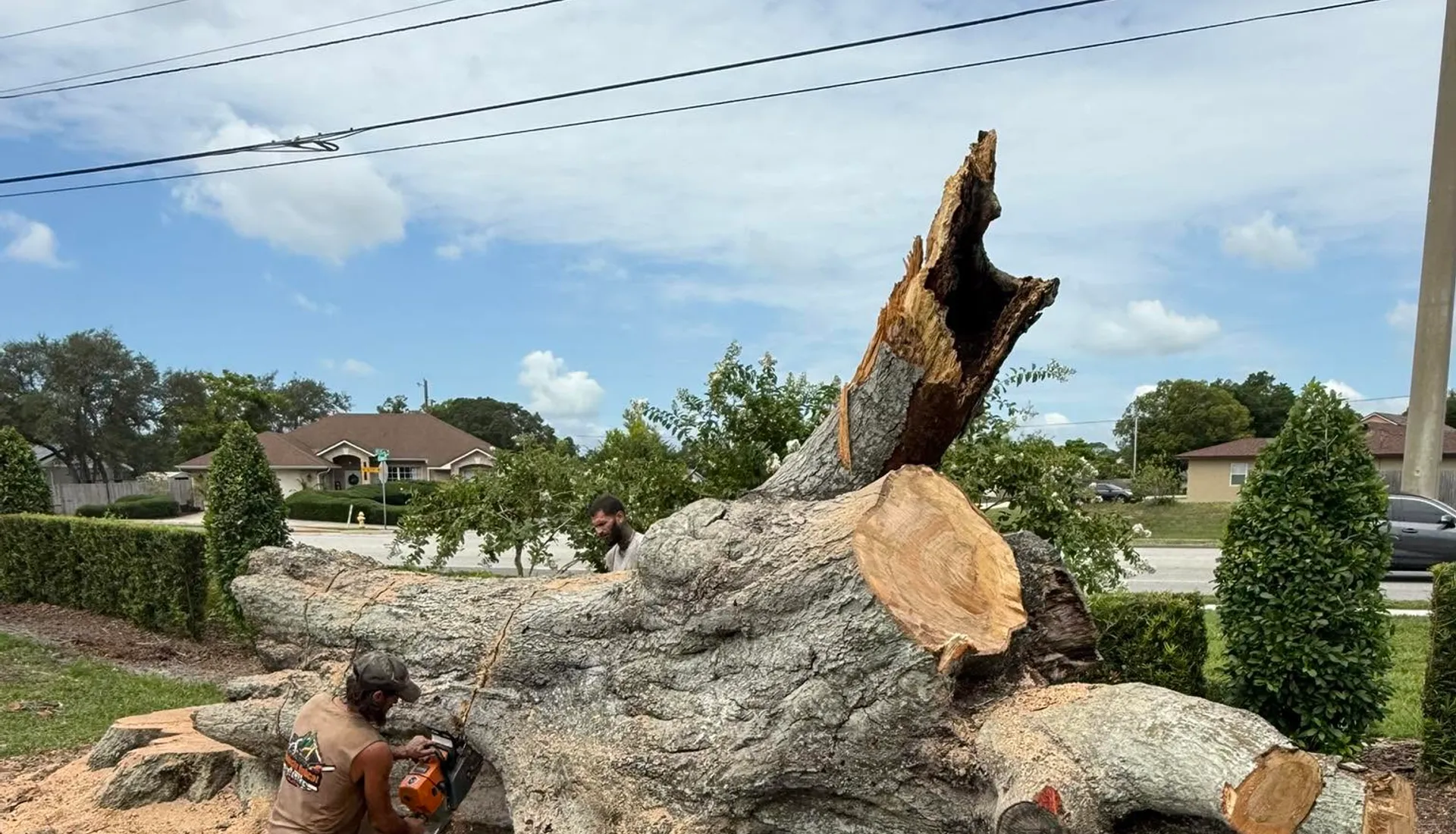
The regulations are there for a reason. Urban forestry is important in a town like DeLand, where the tree canopy is part of the character. Removing a tree should be a last resort, after considering cabling, bracing, or disease diagnosis. But when removal is the right call, doing it safely and legally is the only way.
Emergency Tree Removal After Storms
Florida weather is unpredictable. A summer thunderstorm or a hurricane can bring down a tree in seconds. Emergency tree removal after a storm is a different kind of work. The tree is often leaning on something, maybe a roof or a car, and the ground may be saturated. A bucket truck might not be able to get close enough, and climbing a storm-damaged tree is dangerous.
Cranes are invaluable in these situations. They can lift a fallen tree off a structure without causing more damage. They can also reach over debris to access the root system or the trunk. I have been on calls where a crane was the only way to remove a large oak that had crushed a porch, without pulling the porch down with it.
For homeowners, the key is to call someone who has experience with emergency work and who carries the right insurance. Not every tree service has a crane or knows how to use one safely around structures.
Cost and Value
Crane tree removal costs more than a standard removal. You are paying for the crane truck, the operator, the rigging, and the extra time it takes. But the value is in what you avoid. A tree falling the wrong way can cause tens of thousands of dollars in damage. A crane eliminates almost all of that risk. When you factor in the cost of repairing a roof or a fence, the crane starts to look like a bargain.
Also, a crane job often takes less time on site than a climbed removal, especially for large trees. The crew spends less time cutting and more time lifting. That can actually reduce labor costs, though the crane itself adds a flat fee.
Choosing the Right Crew
Not every tree service offers crane work. It requires a crane operator who understands tree rigging, and a climber who knows how to set cuts for a crane pick. The two have to communicate constantly. If you are considering crane tree removal, look for a company with ISA certified arborists on staff. Certification means they have training in tree biology, risk assessment, and safe work practices. It is not a guarantee, but it is a good sign.
Ask about their experience with similar jobs. Have they removed a tree from a tight backyard in DeLand before? Do they have a relationship with a local crane service they trust? The answers will tell you a lot.
Tree removal is not something most people think about until they have to. But when the time comes, knowing the options makes a difference. Crane tree removal is not the first choice for every job, but for the right tree, in the right spot, it is the smartest one.